
AI transcription has crossed a tipping point. In 2024, the global AI transcription market was valued at $4.5 billion. By 2034, it's projected to reach $19.2 billion — a 15.6% compound annual growth rate that signals a massive industry shift. The reason is simple: AI transcription now delivers 95–98% accuracy on clear audio, costs 5–20x less than human transcription, and returns results in minutes instead of hours. For most use cases — meetings, podcasts, interviews, lectures, social media content — AI isn't just good enough. It's better.
This article breaks down the real numbers behind the shift, explains where AI still falls short, and helps you decide which approach fits your workflow.
The accuracy gap has nearly closed
The biggest argument against AI transcription used to be accuracy. Human transcribers consistently delivered 99%+ accuracy, while early speech-to-text tools struggled to break 85%. That argument no longer holds.
In 2026, leading AI transcription engines achieve 95–98% accuracy on clean audio with standard accents. A 2025 industry survey of 1,200 transcription users found that 73% rated AI transcription as meeting or exceeding their accuracy needs without any human review. The English word error rate (WER) for top-tier AI systems has dropped to 3.5% — meaning 96.5 out of every 100 words are transcribed correctly.
To put this in perspective: a 60-minute interview produces roughly 8,000 words. At 96.5% accuracy, that's about 280 words that may need correction. At 99% human accuracy, it's about 80 words. The difference is real, but for most content — meeting notes, podcast show notes, video captions, content repurposing — it's not worth the 10–20x price premium.
Cost: the numbers don't lie
Here's where the case for AI becomes overwhelming:
| Factor | AI Transcription | Human Transcription |
|---|---|---|
| Cost per minute | $0.05–$0.25 | $0.72–$1.50 |
| 60-min interview | $3–$15 | $43–$90 |
| Turnaround time | 1–10 minutes | 12–48 hours |
| Accuracy (clean audio) | 95–98% | 99%+ |
| Scalability | Unlimited parallel processing | Limited by headcount |
| Availability | 24/7, instant | Business hours, queue times |
A content creator who transcribes 20 hours of video per month would pay roughly $60–$300 with AI versus $860–$1,800 with human transcribers. That's a difference that changes whether transcription is viable at all for small teams and solo creators.
Organizations implementing AI transcription report cost reductions of up to 70% compared to traditional human services, according to market research from 2025. For businesses processing high volumes — call centers, media companies, research firms — the savings scale into six figures annually.
Speed changes everything
Cost matters, but speed may matter more. When a human transcriber takes 24–48 hours to return a transcript, your workflow stalls. You can't publish the blog post, send the meeting summary, or create the subtitles until the transcript arrives.
AI transcription eliminates this bottleneck entirely. A 30-minute recording is transcribed in under 3 minutes. A 2-hour podcast episode takes about 10 minutes. You get the transcript while the context is still fresh — while you still remember what was said and can quickly scan for errors.
This speed advantage compounds in real-world workflows:
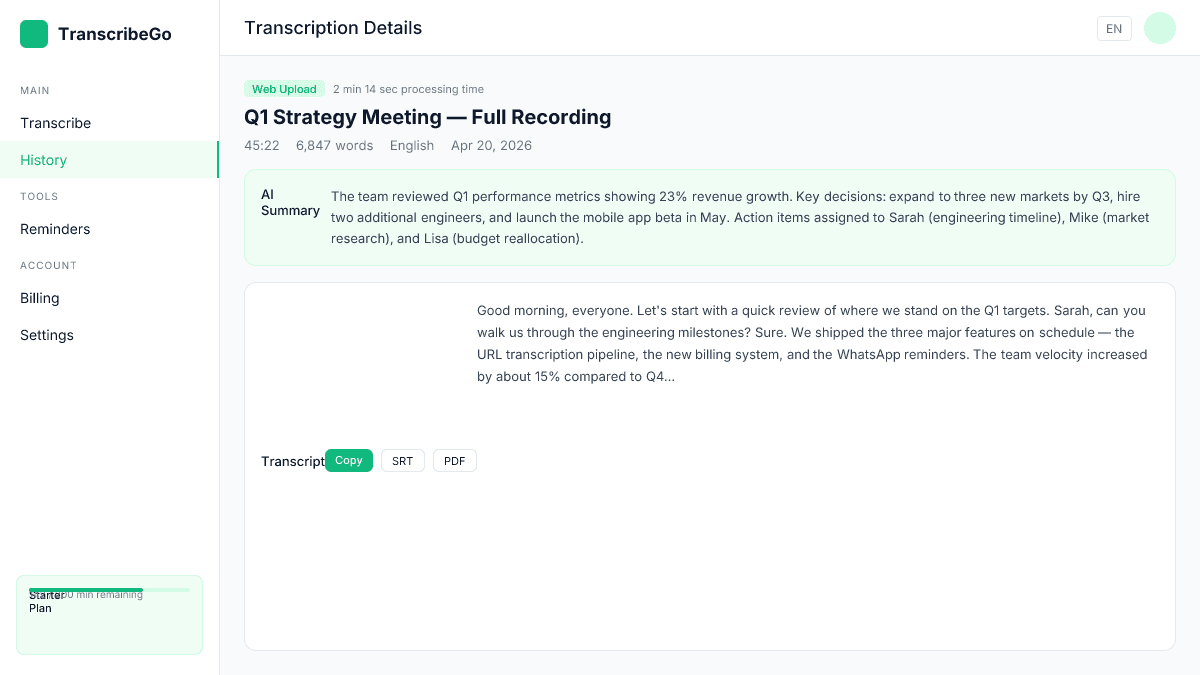
Content creators can publish same-day instead of waiting days. A YouTuber who records in the morning can have subtitles, a blog post draft, and social media clips ready by afternoon.
Students get lecture notes before their next class, not three days later. They can review, highlight, and study while the material is still top of mind.
Journalists can file stories faster. Interview transcripts arrive in minutes, not the next business day. In breaking news, this speed difference is the story.
Meeting participants receive action items and summaries before they context-switch to the next meeting.
Where human transcription still wins
AI transcription isn't perfect for every scenario. Honesty about its limitations helps you make smarter decisions about when to use which approach.
Heavy accents and dialects
AI models are trained primarily on standard accents. If your audio features heavy regional dialects, code-switching between languages, or speakers with strong non-native accents, accuracy can drop to 85–90%. A human transcriber familiar with the dialect will outperform AI here.
Overlapping speakers
Meetings where multiple people talk simultaneously remain challenging for AI. While speaker diarization (identifying who said what) has improved dramatically, crosstalk still causes errors. Human transcribers use context and familiarity with speakers to handle this better.
Legal and medical compliance
Legal depositions, court proceedings, and medical dictation require verbatim accuracy and specific formatting standards. A single error can have legal consequences. These fields typically mandate human review, and for good reason — the cost of an error far exceeds the cost of human transcription.
Highly technical jargon
If your audio is dense with proprietary terms, internal acronyms, or specialized vocabulary that doesn't appear in standard training data, AI may misinterpret key terms. Human transcribers who specialize in your industry can be briefed on terminology.
The hybrid model: best of both worlds
The most efficient approach in 2026 isn't purely AI or purely human — it's a hybrid. Use AI for the first pass (instant, cheap, 95–98% accurate), then apply human review only where accuracy is critical.
This hybrid workflow has actually made skilled transcribers more valuable. Instead of typing from scratch at 4x real-time speed, they now review and polish AI-generated drafts — covering more volume in less time and commanding higher per-project rates for their expertise.
For most users, though, the AI-only path is more than sufficient:
- Podcast show notes and blog repurposing — 95% accuracy is fine when you're editing anyway
- Meeting summaries — you need the key points and action items, not a verbatim record
- Video subtitles for social media — viewers read fast, minor errors go unnoticed
- Student lecture notes — personal reference material doesn't need perfection
- Content research — searching through transcripts for quotes or themes works at any accuracy above 90%
What the market data tells us
The numbers paint a clear picture of where the industry is heading:
- The AI transcription market will grow from $4.5B (2024) to $19.2B (2034) at a 15.6% CAGR
- Meeting transcription is the fastest-growing segment, surging at 25.62% annually — from $3.86B in 2025 to a projected $29.45B by 2034
- 73% of transcription users report that AI meets or exceeds their accuracy needs without human review
- Organizations using AI transcription see up to 70% cost reduction versus human-only services
- The English word error rate has dropped to 3.5% and continues to improve year over year
These aren't projections from AI optimists. They're numbers from market research firms, industry surveys, and platform benchmarks. The shift is happening, and it's accelerating.
How to make the switch (without the learning curve)
If you've been paying for human transcription or doing it manually, switching to AI is straightforward. Here's what a typical workflow looks like with TranscribeGo:
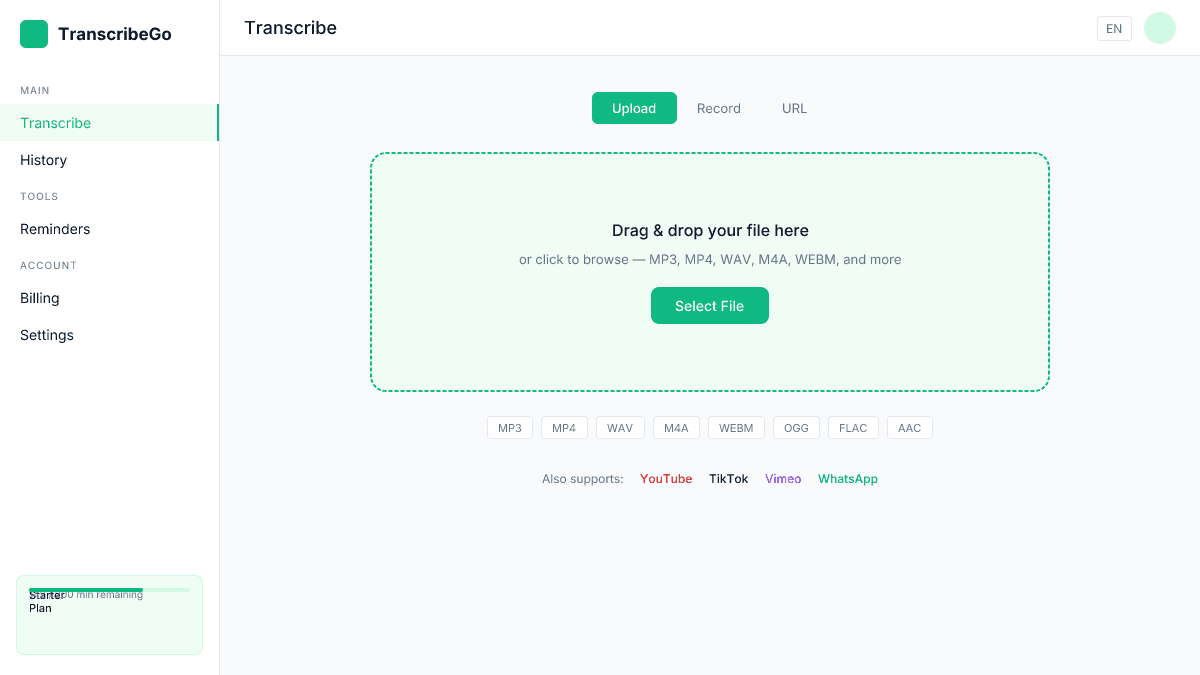
For audio and video files: drag and drop your file into TranscribeGo, select your language, and hit Transcribe. Results arrive in 1–5 minutes depending on length. You get the full transcript, an AI-generated summary, and one-click export to SRT, PDF, or plain text.
For YouTube, TikTok, and Vimeo: paste the URL, and TranscribeGo extracts and transcribes the audio automatically. No download step, no file conversion, no wasted time.
For WhatsApp voice notes: forward your voice note to the TranscribeGo bot on WhatsApp. The transcription arrives in the same chat within seconds.
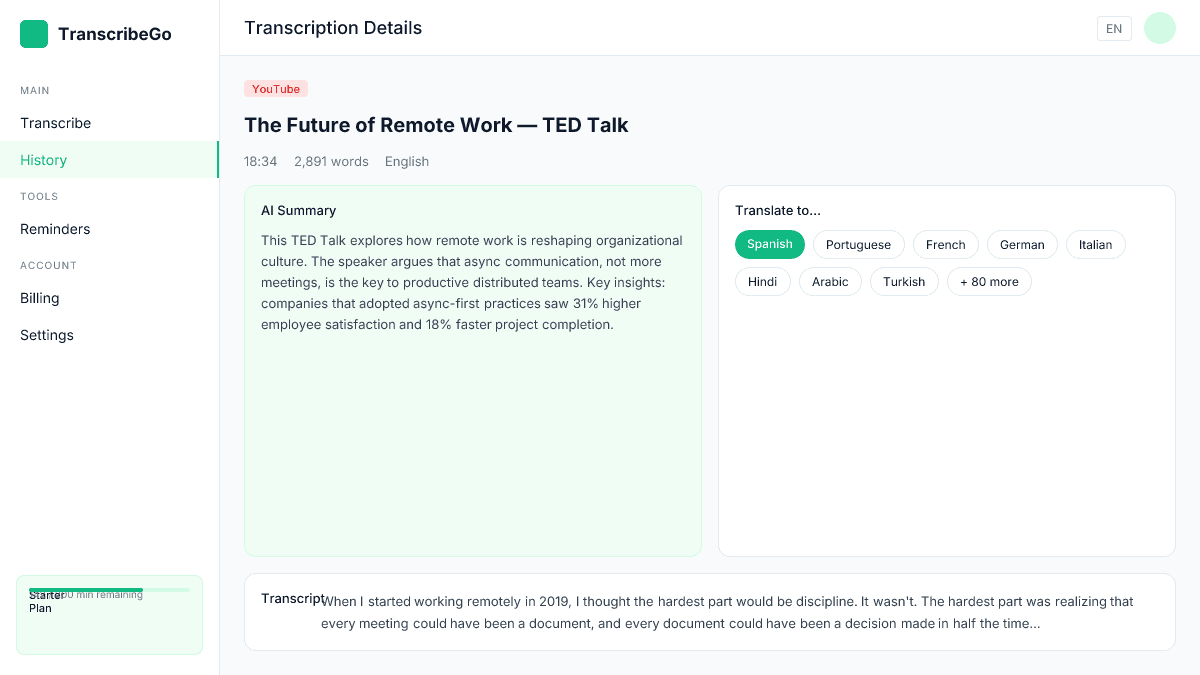
Every transcription can be translated to 90+ languages with a single click — something human transcription services charge extra for (when they offer it at all).
Pricing that makes sense
Human transcription services typically charge $0.72–$1.50 per minute, with rush fees on top. For a freelancer or small team, that adds up fast.
TranscribeGo offers three tiers designed for different volumes:
- Free: 10 minutes/month — enough to test the accuracy yourself
- Starter ($3.99–$6.99/mo): 200 minutes — covers most individual creators and students
- Pro ($12.99–$19.99/mo): 1,000 minutes — for teams, podcasters, and heavy users
Compare that to transcribing 200 minutes with a human service: $144–$300/month minimum. The math speaks for itself.
Try TranscribeGo Free
10 free minutes. No credit card required.
Is AI transcription accurate enough to replace human transcribers?▾
For most use cases, yes. AI transcription achieves 95–98% accuracy on clear audio in 2026, which meets the needs of 73% of transcription users without any human review. For legal, medical, or compliance-critical content, human review is still recommended.
How much cheaper is AI transcription than human transcription?▾
AI transcription costs $0.05–$0.25 per minute compared to $0.72–$1.50 per minute for human transcription — roughly 5–20x cheaper. A 60-minute recording costs $3–$15 with AI versus $43–$90 with a human service.
How fast is AI transcription compared to human transcription?▾
AI transcription returns results in 1–10 minutes regardless of audio length, while human transcription typically takes 12–48 hours. A 30-minute recording is usually transcribed by AI in under 3 minutes.
When should I still use human transcription?▾
Human transcription is still the better choice for legal proceedings, medical dictation, audio with heavy accents or overlapping speakers, and any content where a single error could have serious consequences. For everything else, AI transcription offers a better cost-to-quality ratio.
Can AI transcription handle multiple languages?▾
Yes. Modern AI transcription supports dozens of languages natively. TranscribeGo transcribes audio in 90+ languages and can translate the resulting transcript to any of those languages with one click — a capability most human transcription services either don't offer or charge significantly more for.